Showing posts with label Black Krim. Show all posts

Friday, May 30, 2014

Big seedlings, ready for the big pots

My approach this year was rather simple.  I used soil-less potting mix for plants with a little fertilizer mixed in. My choice was Jobe's Organic Tomato Fertilizer.  It seemed to have just about everything I needed.  I've read up on all of these techniques people use, with so many different types of fertilizers and additional minerals to include Azomite powder.  Is it overkill?  Maybe... Or perhaps it makes sense if growing a lot of tomato plants.  With my intention to have just 5 altogether, I couldn't see the merit of spending all that money on what might only give me a 10~20% boost in productivity.  I did learn quite a bit from last year.  NO SOIL.  Only potting mix.  And, I started with Jobe's fertilizer right off the bat.

My seedlings took off.  Lots of good weather and also good timing on bringing my plants inside before torrential rainfalls or very chilly nights helped them out quite a bit.

A Variety of Tomato Plants

Russian Oxheart

Sara's Galapagos

And just about a week later, you could see a measurable improvement:

Black Krim in mini Sub Irrigated Pot

Sara's Galapagos


I'm hopeful this will be a really good growing season.  I'm definitely looking forward to the variety of heirlooms I chose this year.

Wednesday, October 2, 2013

The Best of the Harvest

It has been just about a week since my last posting. Since then I have harvested the largest tomatoes of the growing season that my plants created. The two largest turned out to be 10oz and 11oz. They have a weird "navel" like formation on the bottom, as each of them are really two tomatoes kind of conjoined. The remaining ones are quite a bit smaller, coming in at 7oz or less. A couple turned out to be about as small as the typical mini-tomato variety.


I didn't take many photos in the latter half of the tomato season, as I'd been a bit exasperated at not having gotten nearly as many tomatoes as I'd anticipated. The only thing really keeping me thankful was hearing about the horror stories of other tomato growers, who lost entire crops to blight, poaching by animals, or just miserable weather conditions.  But what really has me hooked is... THE FLAVOR. I'm a fan of Kumato tomatoes and have been buying them instead of the bland beefsteaks you typically find at the supermarket. Well, these Black Krim tomatoes make the Kumato taste like a bland hothouse tomato!  Amazing... I've been spoiled.  ;-)


Ultimately, I do have a lot to be thankful for. First of all, I learned a ton about tomato growing. If I'd run into my blog as it is now before I got started, assuming it was someone else who posted all this last growing season, I'd have skipped nearly all of the mistakes that first time tomato growers tend to make. And I'd probably have harvested about 60% more tomatoes as a result. So... if my blog gives you that boost, please post and let me know--it would feel good hearing that I've made a positive difference for some other folks.

The next big thing to wonder about is what to grow next year. I already have a big bunch of seeds I harvested from my Black Krim tomatoes, so I will grow this variety again. I also bought some seeds from Gary Pilarchik, namely Russian Orange Oxheart 117 and Sara's Galapagos. He threw in Black Plum as a gift, but I'll probably get them going as seedlings and then give them to my neighbors for growing in their garden. I'd really like to try a couple more varieties, but if I'm still living where I am I won't have a lot of room to grow more than just 4 varieties. TomatoVille has some topics about what have been people's favorites ["What are your favorites this year", "2013 tomato variety report -- winners", and "What are you growing next year, no matter what"]. Those are packed with responses, so you need a lot of time to peruse. I'm very tempted to grow about 8 more varieties, but... I'll have to whittle it down to just 2 more.

Monday, September 23, 2013

Black Krim future harvest

Well, it's a world of difference between the two plants. While the parent plant is towering over 6' (would be closer to 7' if I hadn't encouraged the main stem to bend over), the "offspring" plant is just barely 4' tall. But height doesn't matter when it comes to production in this case, as the smaller plant has been gestating some really good sized fruits. Obviously the potting medium must have made a difference, in addition to the warmer months of mid summer and a more regular fertilizing effort. But I'm hopeful that the enhanced center wick basket I installed when I modified the container has helped too.

My hands take XL sized gloves, so this is no small tomato!


This is probably the most perfectly shaped Black Krim tomato I've seen yet


Unfortunately the massive downpour we had the other night induced some cracking in the fruits, but thankfully they're rather thin and healed quickly. That's one of the downsides of home grown heirloom tomatoes, is that you're going to get all kinds of visual flaws like peculiar shapes and scars from cracking and other incidental damage. But the taste... that's what it is all about.

I counted 12 tomatoes ranging from tennis ball to "full hand" size. There are also a number of smaller tomatoes from stalled blossoms that are trying to catch up, but I'm not very hopeful they'll make it to a decent size.  All in all, this plant is not doing bad considering how late in the game it was started. I just wish I'd had a bigger crop, not only for myself to enjoy but to share with friends and family!

Wednesday, September 18, 2013

The dreaded BER continued

[Note: Delayed posting, content from 4-7 days ago]

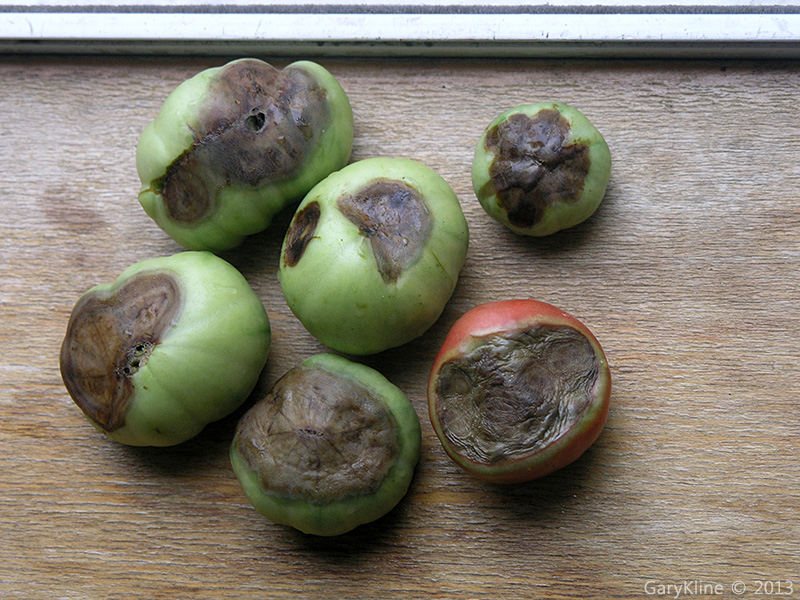
As I noted earlier, my primary Black Krim tomato plant began to suffer from BER late in the season. From what I've read, BER typically strikes plants in their early growth stages but this by no means absolves them of sensitivity to it later on.


I ended up removing 8 tomatoes that were suffering from BER and later on discovered another 4 that had succumbed to it. At this point, there's about a handful of tomatoes left growing on this enormous plant. It would seem almost a waste to keep it going... all of that watering and nutrients needed for a huge plant that has barely a half-dozen fruits on it. And at this point, it's too late in the season to be concerned with pollinating any flowers. Anyway, after a long examination, I found a few more small tomatoes and I've determined that there's enough of a healthy crop to keep it going.

And that leaves me with the small sucker that I'd rooted and kept "dwarfed" for about a month. I'd transplanted it in a larger pot when I noticed 3 tomatoes having set. I figured why not get a couple of extra fruits for just a bit of watering and fertilizer?  Wrong. All of the sudden I saw it--the dreaded BER. Bottoms of the tomatoes turning brown. All three of them. "Gosh darn it!" (instead of a string of curses).  It's just too late in the season now, even though I could have continued nursing it indoors. I raised it from the pot, put it in a plastic bag, and tossed it outside. Amazingly enough, one week later and the plant is still alive and the BER inflicted tomatoes have remained unchanged. It's sad, but there's just not enough time for it to grow new fruit...

There is one important consideration with tomatoes, and that is the genetic strain of a given variety. Apparently they are not all created equal. Some strains will be a little less resistant to disease and other maladies, while others will be more hearty/robust. I've read up quite a bit on postings from seasoned tomato growers and it's not a shallow subject by any means. The operative word is "stabilization".  Some strains floating about in the wild are simply not as stable as others. And you can see this exhibited in various forms. One such characteristic is the appearance of peculiar looking fruits (what some call "cat faced") among the normal ones. This is the result of environmental issues at pollination time (such as too much nitrogen, low temperatures, etc). A heartier strain will require more taxing conditions to cause the cat-facing of tomatoes, while others will almost always churn out a few of these oddities during the growing season.

But moving onward, I'm really looking forward to the coming weeks as I finally get to harvest some of the largest Black Krim fruits I've seen yet.  The first rooted sucker I've had going has definitely outpaced the parent plant not only on the volume of tomatoes but their size as well. This speaks volumes about how important soil and fertilizer is and experiencing it first hand has really "driven it home".


This photo was taken about 10 days ago as of this posting and their even larger. I will definitely weigh them once off the vine, to see just how hefty they actually are (maybe 12 oz?). The first sign of blushing appeared on one of the smaller tomatoes, so these should be catching up in the next week or two.

Monday, September 2, 2013

Potting Medium Makes All The Difference

As I noted earlier in my blog, I'd started a Black Krim plant from a rooted sucker, but this time applied some of the things I'd learned in the course of growing the parent plant.  The difference is rather amazing.  Here are some of the things I've noticed:

  • The plant has grown faster, and I think only part of this was due to the warmer weather conditions of mid summer.
  • The leaves are larger and only the bottom most branches have shown curling, whereas on the parent plant a majority of the leaves have curled. Side by side, it's clear that the second plant looks healthier.
  • Fruit production not only happened earlier but at a faster pace.
  • BER struck the parent plant (I've lost 8 tomatoes to it), but not the transplant.
Black Krim Parent 6' Tall -- curled leaves galore

Black Krim Parent -- common leaf detail
Given the state of the plant... and the continuing appearance of BER, I'm a week or so away from aborting it altogether because of this:

Black Krim Transplant -- large and lush healthy leaves
Clearly there's a huge difference between the plants. The potting mix makes for a much healthier environment than the fertilized top soil.  In retrospect, I saved about $8 by going with the top soil, which was a savings that can't even begin to match the effort spent in dealing with plant issues and an anemic production for most of the early season.

By the way, I started a little experiment...

After I successfully rooting the sucker (mentioned earlier) and got it growing into a productive plant, I decided that 3 large SWC containers was enough. I wasn't going to add any more to the inventory for this growing season. However, I did have one sucker that had sort of half-rooted and I figured I'd see how long I could delay its growth in a traditional small pot. I wasn't watering it diligently, but it kept on growing at a snail's pace. It was starting to outgrow the container, but I kept it in the pot to see if growth would be noticeably stunted. Water uptake was increasing and the plant started to flower. But I never expected any of of the flowers to pollinate. I didn't help it along in any way.

Well, I suddenly spotted a swelling on one flower and couldn't believe it--a tomato was growing. Not only that, but another two smaller ones were starting as well on the same truss. There's no way this plant would be able to grow any decent tomatoes being kept in that cramped pot. I had a decision to make. Either I abort the plant or I let it grow. I chose the latter. I got out another standard plastic pot about double the size, filled it with potting mix and fertilizer, then transplanted it. It reacted well and sprouted a sucker, that I had to pluck. I don't want this plant to have more than one production stem. It's going to be an experiment, where I'll be bringing it indoors as the fruit it is bearing nears the ripening stage. I honestly don't expect to get more than 5 or fewer tomatoes from it. But it'll be interesting to see how long I can grow it after the season finishes out. Once one of the other plants dies off, I might transplant this one into the larger container if it is demonstrating to be an able producer (of course I'd have to hand pollinate all of the flowers). I'm quite tempted to abort the parent plant and give it a shot in a much bigger pot (no rhyme intended--wink).


EDIT: [Unfortunately, those promising tomatoes shown above ended up contracting BER. I'm guessing that the suppressed conditions I'd put the plant under having kept it in such a small container left it ill prepared to bearing fruit. I'd watered it sufficiently and fertilized as well, but this did nothing to stave off the affliction.]

As it stands right now, I've been actively pruning my other plants. Aside from sucker plucking, I'm also nipping off the tops and trimming flowers, as there simply isn't enough time to start new tomato growth that will mature enough by the end of autumn. Plus, I don't want to be struggling with the plants as late October/early November rolls around, assuming they don't start dying off.

Saturday, August 24, 2013

Well, it finally happened -- "Got BER"?

When I initially planted my tomatoes, I mixed in pulverized eggshells with the soil to provide a nice solid foundation of calcium to feed the plants for their growth into maturity. I figured I might have to supplement a little towards the end of the growing season, but it wasn't foremost in my mind.

Well, the other day I noticed some black spots on the lower sides of a couple tomatoes. It looked like BER (blossom end rot), but it wasn't directly at the bottom. BER has always looked to me like it doesn't compromise the shape of the tomato much, just turns it brown as if soaked in dirty oil. But it can cause a significant depression in the skin, which is what I was seeing.

BER is usually caused by a calcium deficiency, but not necessarily due to a lack of calcium in the potting medium. The common cause is dramatic swings in potting medium moisture, going from dry to soaking wet and back, that impedes the ability for the plant to uptake calcium from the soil. This did happen to my BK... when I'd let it go about 3 days between watering. There appears to be little margin of error with container growing. If your water supply runs dry, the plant starts suffering very shortly thereafter.


Instead of allowing the fruit to continue growing, I picked it since I didn't want any precious nutrients devoted to a failing prospect. Thankfully the two others that have small BER like depressions in their sides have not shown any BER progression.  Hopefully they'll avert that fate.

UPDATE: Unfortunately, the tally went higher. I've had a total of 8 tomatoes that were struck by BER...


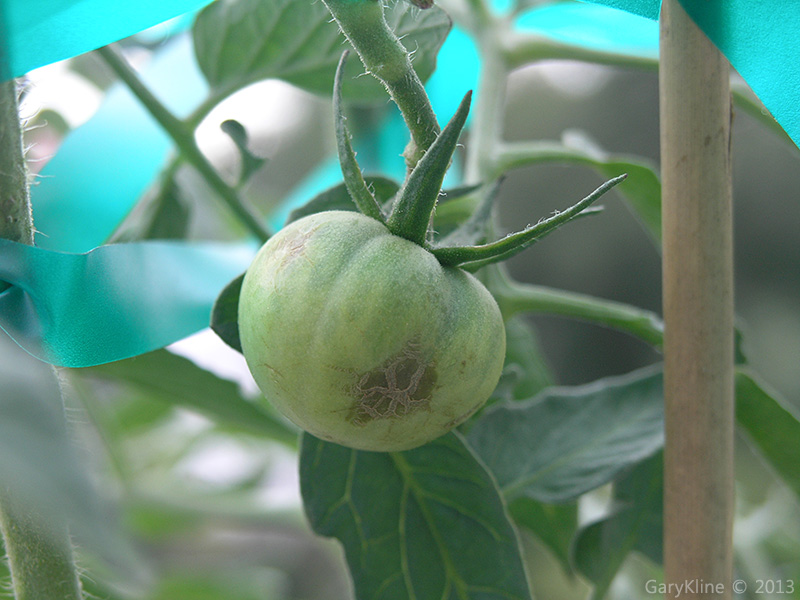
Here are some other examples... one looks like BER but the other seems to be more like a lesion (hopefully minor and won't spread):

Peculiar lesion on the side, with segmented pattern

Front one is likely stake rubbing, but tomato behind it has a classic BER side dimple
BTW. today I noticed the BK parent plant has been increasing water intake. We had a major rainfall just two days ago and when I checked the plants yesterday they had decent reservoir water levels. But when I checked this morning, the BK was nearly dry. Several leaf clusters near the top had softened and started drooping and the tallest production stem was bending over. I promptly filled the reservoir in addition to a little watering from the top and within about 15 minutes, the plant showed a significant response. Another 15 mins after that, I noticed the reservoir was down about a quarter! This plant was really thirsty. First time I'd ever seen this.

Meanwhile, I picked another lemon boy and it was interesting to see the stark contrast between freshly picked and counter-top ripened, essentially lemon vs. cadmium yellow.


Friday, August 23, 2013

Sometimes a dormant pollinated flower can spring to life

I'd heard about this from a couple of people, but wasn't quite sure if I'd ever see it--a fertilized blossom stalled for many weeks, that suddenly starts growing fruit.

Earlier in my blog, I showed this photo with the "team of three" flowers on one particular truss, all looking like they had pollinated but nothing else, no tomato growing. Just a shriveled anther cone and stillness:


After a few weeks, I managed to nick off the anther cone of the one on the right. About a week later, all of the sudden it started to shrivel up. I'd never seen this happen before, where all of the sepals simultaneously browned. Usually the stem knuckle goes yellow and the whole thing falls off. But perhaps having been on the truss for so long, the connection was too solid for it to drop. It looks like something straight out of a Tim Burton movie:


Well, a few more weeks after this, and the center flower started growing a tomato! This is more than 6 weeks of having just sat there, doing nothing:


Pretty remarkable, isn't it? I've counted one other tomato on this plant that also sprang back to life after being dormant for more than 4 weeks. It's an interesting thing to witness and it definitely suggests that you should never pluck off any blossoms that are just hanging around with dried anther cones and healthy sepals. They could end up growing into tomatoes at some point when the plant has the resources to spark them into action.

Tuesday, August 20, 2013

The Mutants Have Arrived


Really weird looking, eh?  I'm not quite sure what to make of them.  These are on the Black Krim parent plant. These are the exception, thankfully. But I've also noticed a couple of similar shaped tomatoes (although not as extreme) on the Lemon Boy. I wonder if there's some peculiar aberration with the pollination going on.

At least they're not growing any eyes in those sockets, like this:


I have one peculiar looking tomato like this on the Black Krim seedling, but it looks like the others are mostly normal. Incidentally, that seedling (now BK#2 plant) is going gang busters with fruits. Amazing what a difference my chances made (potting mix instead of top soil, plenty of fertilizer up front, and a modified SWC for better wick action through the mix).


There's currently 12 fruits going on this seedling, although a couple look a bit mutant like. Also, the bottom ends on a few have black spots which... I'm hoping does not turn into BER (blossom end rot).


Speaking of BER, the parent Black Krim plant is suffering from it on two tomatoes. The typical culprit is calcium depletion, so I've added my pulverized eggshells to my watering regimen in hopes of curing it. Otherwise, this plant has now reached over 6' tall (including the pot), with some fruits above eye level.  Pretty wild. I never expected it would grow this tall in that puny 6 gallon container.


I've counted 19 fruits in various stages of growth on the parent plant... as though it were trying to make up for lost time. I'm kicking myself for not fertilizing enough earlier on... but that's "water under the bridge". Unfortunately a few are exhibiting some unwanted characteristics like black speckles and some deeper spotting that is reminiscent of BER... although not specifically focused on the center of the bottom (as is typical with BER). I'm hoping the natural calcium infusion will resolve this affliction and that it will remain isolated to just a couple of fruits.


Wednesday, August 14, 2013

Like the economy, production is increasing!

If you've been reading my blog, you already know that I'd had a tough time with the Black Krim tomato plant I've been growing this season. The plant is generally fine and healthy, but fruit production has been next to nothing. I planted it back in late May and thus far, I've picked only ONE tomato from the plant. Well, the good news is that I've got 5 more tomatoes growing on it. And I've still got several flowers that may have fertilized but were stopped before committing to full tomato growth, possibly due to insufficient fertilizing of the soil.


What I've been doing now is applying Jobe's Tomato Vegetable and Food fertilizer every other watering, and then adding a high nitrogen rich fertilizer combined with Epsom salts on the alternate watering. We've been getting some pretty strong rainy days here and there which is the "regular" watering, that probably flushes out fertilizer. Container growing is definitely a different type of gardening and you have to rethink your ways, as nutrients do not stay in the soil as well as with in-ground soil. So... I may actually get a few decent tomatoes for the tail end of the season.

The Black Krim has now topped out at over 5' tall.  This is a BIG plant, for container growing. Unfortunately, that cluster of two tomatoes you see above is at the top end, so I definitely don't want to trim those off in trying to contain the height. But I will probably snip above it.  The only issue is that flowers are much more abundant at the top, rather than below. I wonder if cutting them prematurely will incite the plant to try growing them further down the plant.

The Black Krim seedling is doing fine and finally has its first tomato. It's a little peculiar looking with a slight misshapen appearance, but hopefully it'll grow out of that and look mostly normal. There is an abundance of flowers for its size and I'm trying to get them pollinated. I've let one sucker grow into a secondary production stem, and I might leave it to just 2-3 of them.


The Lemon Boy had a slight problem at one point, where the reservoir ran dry and then I thoroughly watered it after that (watering from above to moisten the soil and also filling the reservoir). As a result, some cracking appeared on a couple of fruits. The cracks healed and didn't look too bad when the tomatoes were small, but now that they've enlarged the cracks look more pronounced. At least they won't affect the taste!

Otherwise, it has a nice population of tomatoes continuing to grow that I expect will have a couple ready for picking in about another week or two. I did find one tomato that started turning color while being very small in size (comparable to a golf ball), which was tomato #4. I suspect the lack of fertilizing stunted the growth, or it was just random chance.


The stalled proto-tomato waited for the right time to grow
 As you can see above, this mature cluster has one tiny tomato nestled in the bunch. This was a flower that I thought was going to be aborted. However, it kept hanging on, the sepals staying mostly green and healthy. Since they are all connected to the same truss, I suspect the priority of nutrients were going to the other fruits. Once they achieved a size near maximum, the little runt finally got its due of nutrients and began to grow. It's definitely going to be lonely in a few weeks after the others are reaped.  ;-)

When Lemon Tomatoes Are Smilin'